

Watching Gavin Newsom at Davos in January, I couldn’t shake the feeling I’d seen this act before. The charm, the confidence, the sweeping vision for the future. Then it hit me: he’s MBS.
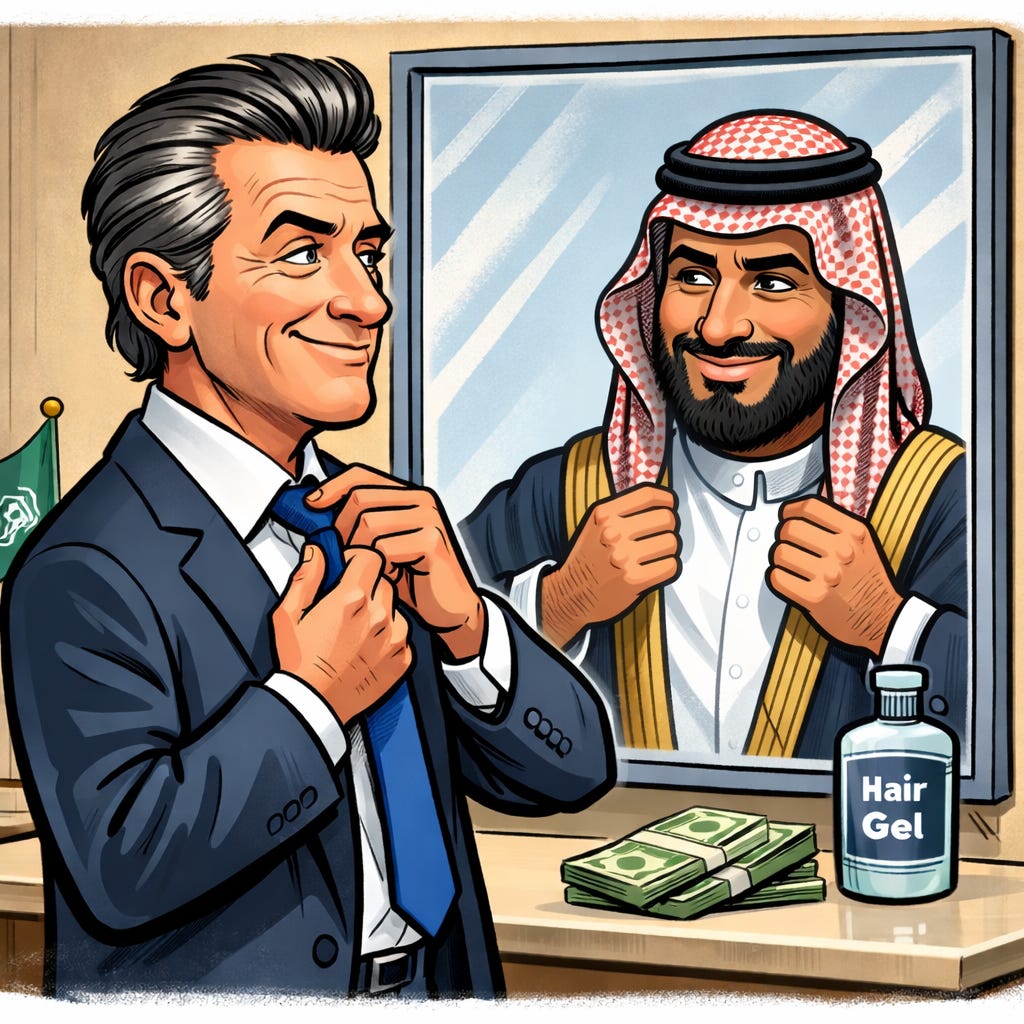
Not literally. But the resemblance goes deeper than style. Both men run petrostates. Both have mistaken a temporary resource advantage for a permanent mandate. And both, I think, have overplayed their hand.
California isn’t a state in the normal sense. It’s a petrostate that exports software instead of oil. And like petrostates everywhere, its government has learned to extract wealth without performing, because the resource can’t leave.
Tech companies are geographically captive in a way other knowledge work isn’t. Network effects are brutal: the talent is here, the VCs are here, the acquirers are here. You can move your headquarters to Austin, but you’ll still need a Bay Area office. You can’t replicate an ecosystem with tax breaks.
When Chicago lost Citadel, it was a crisis. When companies threaten to leave New York, the governor negotiates. When California lost Oracle and Hewlett-Packard, it proposed wealth taxes and exit taxes. That’s not the behavior of a government competing for business. It’s the behavior of a government that knows the resource is captive.
The other petrostate prerequisite is no political competition. The House of Saud doesn’t hold elections. California technically does, but Republicans haven’t won statewide since 2006. The legislature is a Democratic supermajority. The real elections are primaries, where turnout is low and public employee unions write the checks. When you can’t lose power, you stop optimizing for voters and start optimizing for the interests that keep you in power.
To keep its citizens happy, the Saudis have a social contract. The royals extract, but citizens pay no income tax, gas costs 60 cents a gallon, and the government subsidizes housing, healthcare, and education.
California has no such bargain. Captive resource plus no political competition produces a specific pathology: enormous spending with terrible results. The state spends $26,000 per pupil on K-12 education, among the highest in the nation. It ranks 37th in outcomes. Only 35% of fourth graders are proficient in math.
The pattern repeats everywhere. Los Angeles spent $1.3 billion on homelessness in a single year. The homeless population went up. A highway patrol officer can retire at 50 with a $150,000 annual pension. The bullet train has consumed $15 billion without laying a single mile of track, its cost estimate ballooning to $128 billion. (For context, SpaceX has raised $12 billion across its entire 23-year history and rebuilt the American space program).
These aren’t failures. They’re only failures if you think the system is optimizing for residents. If it’s optimizing for wealth transfer to favored constituencies, retired workers, NGO executives, government contractors, the system is performing beautifully.
Every petrostate needs a legitimizing ideology. Saudi Arabia has religion: the monarchy derives authority from custodianship of the holy sites. California has progressivism.
You’re not being fleeced. You’re funding compassion.
The function is identical. Both make it socially ruinous to question the extraction. In Riyadh, you’re questioning God. In Sacramento, you’re questioning justice. Challenge the $128 billion bullet train and you’re against climate action. Ask why $1.3 billion didn’t reduce homelessness and you lack empathy. Wonder why $26,000 per pupil produces 37th-ranked schools and you must not care about children. The ideology doesn’t just justify the spending. It makes the spending impossible to audit.
The billionaires trickling to Miami aren’t fleeing taxes, exactly. They’re fleeing a government that treats them as a resource to mine, and wraps the pickaxe in virtue.
But petrostate models are fragile. They work only as long as the commodity price stays high.
Saudi Arabia needs $90 oil just to balance the budget. Oil hit $70 today. Their Q1 deficit hit $16 billion, more than half the forecast for the entire year, and the year’s barely started. Goldman Sachs projects the full-year number could reach $67 billion. NEOM, the $500 billion fantasy city? The Line has been scaled back from 170 kilometers to 2.4. The sovereign wealth fund suspended construction entirely. The Asian Winter Games they were supposed to host in 2029, indefinitely postponed. The dream is being quietly dismantled.
California’s commodity is capital gains. The state gets half its income tax from the top 1%, mostly stock sales. When tech booms and markets rise, the extraction model hums. But California has been running deficits even during the boom: $27 billion in 2023, $55 billion in 2024.
These are the good times and California is still underwater.
MBS is retreating. Scaling back NEOM, cutting spending, quietly accepting the math. He’s being humbled by the price of oil, and more importantly, he knows it. He’s always known where his power comes from.
Over the past year, $2 trillion has been erased from software stocks. When revenue slows, California doesn’t question the model. It squeezes harder. It thinks the money comes from good governance, not from harvesting network effects.
The well dries up eventually. It always does. The only question is whether you saw it coming. MBS did. Sacramento won’t.