

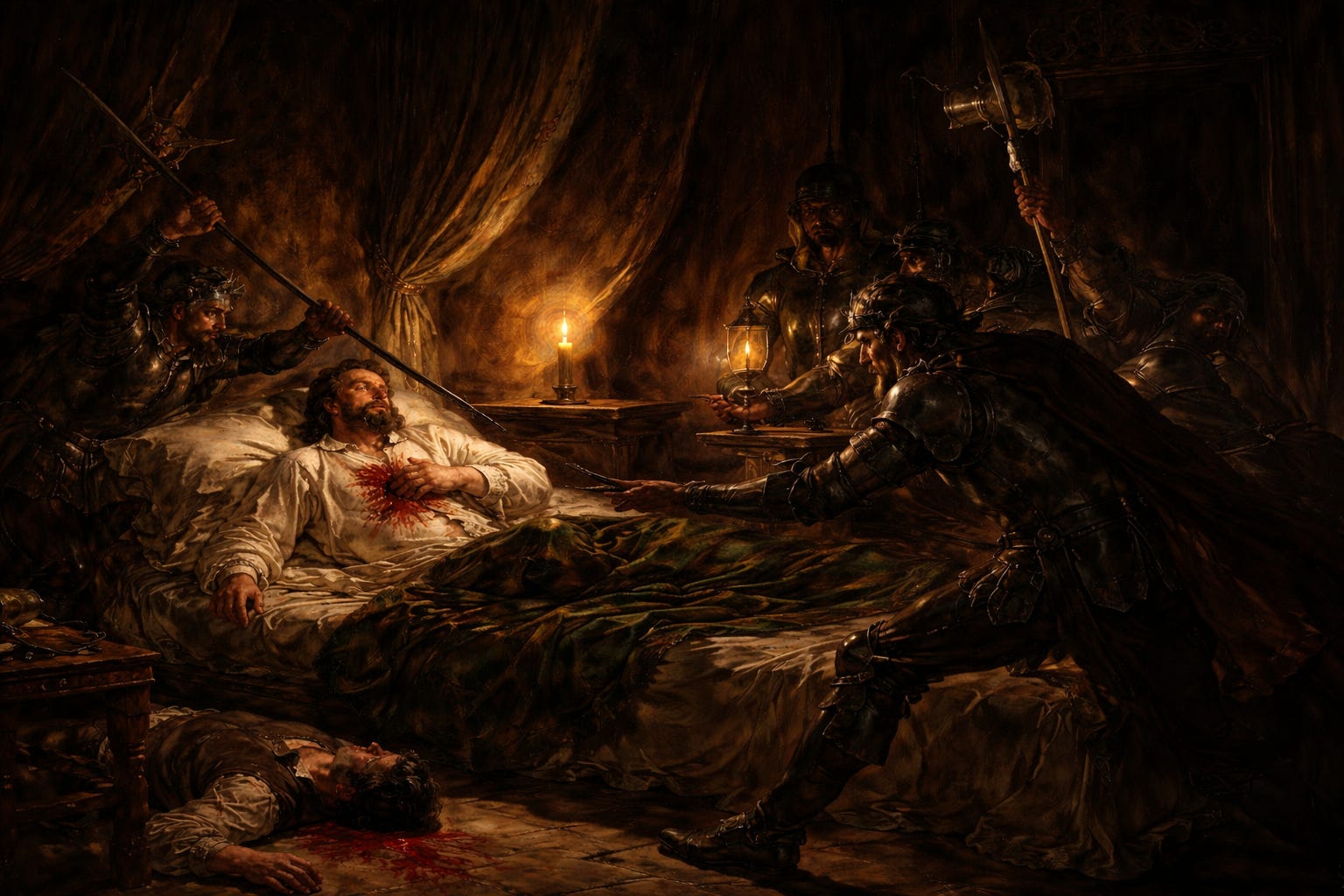
On the night of February 25, 1634, a group of officers climbed the stairs of Eger Castle in western Bohemia. They were looking for their commander.
Albrecht von Wallenstein was the most powerful military entrepreneur in European history. As supreme general of the Holy Roman Emperor’s forces, he had built an army of over 100,000 men, financed largely from his own fortune. He controlled more territory than most kings. And for three years, he had been running a side game that made Qatar look like an amateur.
Wallenstein negotiated simultaneously with the Emperor, the Protestant princes, the Swedish crown, and the French. He took money and made promises to all of them. He played each faction’s desperation against the others, extracting land, titles, and wealth at every turn. His logic was simple: he was too important to lose. Every side needed his army. Every side needed his intelligence. No one could afford to move against the man who held the balance of power in the Thirty Years’ War.
He was wrong.
The Emperor decided that the most indispensable man in Europe was actually the most dangerous. Ferdinand II issued a secret order. That night in Eger, Wallenstein’s own officers found him in his chambers, unarmed and in his nightshirt. Captain Walter Devereux drove a pike through his chest.
Four hundred years later, Qatar was running the same play at a national scale.
They hosted Al Udeid Air Base, CENTCOM’s forward headquarters and home to over 10,000 American troops. They funneled hundreds of millions of dollars to Hamas and sheltered its political leadership in government compounds. They kept back-channels open to Tehran. They brokered negotiations between parties that wouldn’t speak to each other. They were the indispensable middleman: too connected, too useful, too central to hit.
Then every side hit them anyway. Iran fired missiles at Al Udeid during the Twelve-Day War. Israeli jets struck a residential compound in central Doha, killing six Hamas leaders Qatar had been financing and protecting. In January 2026, Qatar told Washington it would not allow its bases to be used for strikes against Iran. The hedge again. Stay in the middle. Don’t provoke.
Iran launched 66 missiles at Qatar on February 28th anyway. By March 2nd, Qatar was shooting down Iranian Su-24 fighter jets, and QatarEnergy, the world’s largest LNG producer, had halted all production. European gas prices surged 50%.
Struck by Israel for funding its enemy. Struck by Iran for hosting America’s base. The indispensable middleman discovered what Wallenstein discovered: when you play every side, you give every side a reason to hit you.
Why?
Not because Qatar was weak. Qatar is rich, armed, and strategically located. They got hit because they were illegible.
No one knew what Qatar actually was.
An American ally? They hosted CENTCOM. An Iranian partner? They kept the back-channels. A Hamas sponsor? They wrote the checks. Qatar was all of these things simultaneously, which meant that every committed player in the region looked at Qatar and saw a variable that needed to be resolved.
This is the pattern. It’s not really about Qatar. MBS made the same calculation: refuse the Abraham Accords, refuse to let Washington use Saudi territory, keep Iran at arm’s length, protect Vision 2030 at all costs. On March 2nd, Iranian drones hit Ras Tanura, Saudi Arabia’s largest oil refinery. Aramco shut down 550,000 barrels per day. The thing MBS was hedging to protect is now under direct threat precisely because he hedged. Iran looked at Saudi Arabia and saw the same thing the Emperor saw in Wallenstein: a player too entangled with everyone to be trusted by anyone.
Starmer did it too. He blocked the US from using Diego Garcia for Iran strikes. The stated reason was international law. The real reason was that Labour’s coalition couldn’t survive being seen supporting strikes on a Muslim country. It was a domestic hedge dressed up as legal principle. Trump said it was unlike anything that had “happened between our countries before” and withdrew support for the Chagos Islands deal. Then Iran hit RAF Akrotiri in Cyprus. Within 48 hours, Starmer reversed course. The UK ended up exactly where they would have been anyway, but with a damaged alliance and nothing to show for the hesitation.
Each one discovered that in a fracturing world, complexity isn’t protection. It’s a target. Committed players don’t tolerate ambiguity. They resolve it.
Iran hit every Gulf state last weekend except one: Oman.
Oman has mediated between the US and Iran for years. It hosted the nuclear talks. It keeps channels open to Tehran. On paper, it looks like another both-sides player. But Oman never played both sides. It picked one role: honest broker. And it never deviated. It didn’t host American military bases while courting Tehran. It didn’t fund armed groups while brokering ceasefires. It was transparent about what it was and what it wasn’t. Iran spared Oman not because Oman was neutral, but because Oman was legible. There was no variable to resolve.
The UAE tells the same story from the opposite direction. They signed the Abraham Accords in 2020. Saudi state media branded them an “Israeli Trojan horse.” Across the Arab world, they were called traitors. They held the line. Never recalled their ambassador from Israel. Never canceled flights. Never froze cooperation.
When 165 ballistic missiles and 541 drones came screaming across the Gulf last weekend, the UAE absorbed the blow, because picking a side had given them access to things hedging never could: Israeli-built Barak and SPYDER air defense systems, fully integrated intelligence sharing with American and Israeli services, years of joint exercises through CENTCOM. The Abraham Accords weren’t a photo op. They were a defense architecture.
Oman was spared because everyone could read it. The UAE leveraged US and Israeli defense partnerships to intercept 95% of incoming missiles. Qatar, Saudi Arabia, and the UK unfortunately paid (and will continue to pay) the price for strategic ambiguity.
The world that tolerated ambiguity is gone. From 1991 to roughly 2020, you could host an American base and a Hamas bureau in the same city. You could buy Chinese 5G equipment and American fighter jets. One power underwrote global security, and the cost of being illegible was low. The contradictions didn’t collapse because the unipolar order held them in suspension.
That order is over. The system is fracturing. And in a fracturing system, every uncommitted player becomes a variable that committed players need to resolve. Wallenstein learned this in 1634. Qatar, Saudi Arabia, and the UK are learning it now.
The UAE understood something crucial: commitment has a price. You pay it upfront, in political capital, in domestic backlash, in being called a traitor by your neighbors. But when the missiles come, you have allies, architecture, and something to stand on.
There is nothing more expensive than not picking a side.